
Compounding is a specific process by which licensed personnel prepares medications for patients with prescriptions when no commercially available medication can address their needs adequately. For example, if you require an unavailable dosage, formula, flavor, or strength – or if there is a nationwide drug shortage of a commercially available drug – a compounding technician or pharmacist can prepare that medication for you with a prescription from your provider. Please note that compounded medications are not evaluated by the Food and Drug Administration.
Commercially available drugs are manufactured by pharmaceutical companies in mass quantities, in predetermined, specific forms, strengths, dosages, and flavors for the consumption of the general population, and are FDA-approved. Compounded medications are ordered by a qualified healthcare provider and prepared by a compounding pharmacy, depending on the patient’s unique medical needs. Please note that while compounded medications are made from FDA-approved ingredients, the final forms of the compounds are not evaluated by the Food and Drug Administration, therefore not FDA-approved. For more information, please see: Disclaimer
With a physician’s prescription, a compounding pharmacist or technician can compound a specific strength or dosage form that is not commercially available (e.g., create a liquid for a child or adult who cannot swallow a pill), formulate the medication to exclude non-essential ingredients (e.g., dyes, gluten, sugar, lactose, preservatives), or flavor certain medications for adherence to taking the medication.
Prescriptions can come from Medical Doctors (MD), Doctors of Osteopathic Medicine (DO), Doctors of Dental Surgery (DDS), Naturopathic Doctors (ND), Physician Assistants (PA), and Advanced Practice Registered Nurses (APRN) within the scope of their practice. Some doctors have limitations on what may be prescribed, which may vary from state to state. Prescriptions to Valor Compounding Pharmacy can be submitted by healthcare professionals. Learn more here
BUD is the Beyond-Use-Date. After this date, Valor cannot guarantee the stability or sterility of the medication. The BUD is calculated from the day the medication is compounded.
You should not use a compounded prescription beyond the labeled “Do Not Use Beyond” use date. Please call us at 855-554-2889 to speak with a pharmacist for any additional questions.
In the compounding pharmacy industry, there are specific definitions, regulations, and licensure that differ between running a sterile compounding pharmacy versus a non-sterile compounding pharmacy.
Sterile compounding follows strict standards and is used when there is a high risk of infection, as sterile compounded medications are typically intended to be used as injections, or ophthalmic sterile compounds for eye drops, and others. Medications like these need to be carefully prepared in a separate sterile clean-room, an environment free from viruses, bacteria, or any other infectious microorganisms to ensure sterility and patient safety.Valor Compounding Pharmacy offers a select catalog of sterile compounds that undergo rigorous testing including method suitability and container closure testing. You can call us at (855) 554-2889 to get more information on our sterile compounds.
Non-sterile compounding is more common and while these drugs are not prepared in a sterile clean-room, they are made with high standards and strict guidelines. Non-sterile compounding utilizes a clean environment where equipment, surfaces, and materials are sanitized. Non-sterile compound medications include solutions, suspensions, ointments, creams, gels, powders, suppositories, capsules, troches, dissolvable forms, and tablets, and are typically taken orally or used topically.
Please note: We do not compound GLP-1s (semaglutide, tirzepatide or other weight loss compounds), peptides, injectables, IV nutrients or vitamins (or any nutraceuticals), or growth hormones.
Unfortunately, Valor is not a take-back site for disposal of medications. You can refer your patients to these resources for determining locations to dispose of medication: https://www.pharmacy.ca.gov/webapplications/apps/takeback/index.shtml and https://medtakebackcalifornia.org/#find-a-location.
We are a NABP Compounding Pharmacy Accreditation, PCAB accredited and LegitScript accredited 503A facility located in Berkeley, CA. As a compounding pharmacy licensed in multiple states in the country, we take pride in serving patients and providers with the highest quality assurance standards we set for ourselves while making the healthcare journey for all parties as smooth as possible with our flat-rate pricing, free shipping, and fast turnaround.
Our dedicated compliance team guides our operations as we apply our proven processes to compounding. Our team consists of individuals who pay great attention to detail, provide excellent customer service while focusing on quality, and are dedicated to raising the bar in compounding pharmacy, making us the Compounding Center of Excellence that we are.
A list of the States We Serve can be found here.
Dosage forms are compound specific. Here is a list of examples
Oral Dosage Forms
– Sublingual tablet
– Troche
– Capsule
– Suspension
– Solution
– Lollipops
Topical Dosage Forms
– Creams
– Gels
– Ointments
– Nasal spray
– Otic powder
– Suppositories
Sterile Dosage Forms
– Injectable
– Eye drops
Please allow up to 3-7 business days to receive your prescriptions after checkout. While several of our compounds are available to ship within 24-48 hours, some custom compounds may take longer depending on your prescriber’s orders, supply chain availability, or specific storage and shipping requirements of your medication.
Yes, we can ship any non-sterile medication to any state in which we are licensed via FedEx. California is the only state in which we ship sterile compounded medications at this time. You will be asked to provide your home address during your checkout process and please note that we cannot ship to PO Box addresses.
See below for a general schedule of ship days and arrival days. Please note that holidays may impact this general schedule. Some compounds only ship Monday-Wednesday due to safe shipping requirements. Follow your tracking number for the most accurate delivery schedule.
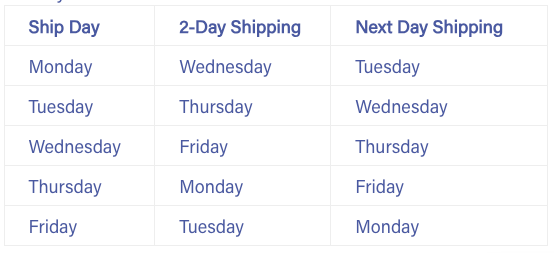
There are a few reasons why you may experience a delay in receiving your prescription.
For new prescriptions, you may have your doctor call us at 855-554-2889, or fax it in at 855-205-8456. If you have a hard copy of your prescription, you may bring it to our pharmacy.
For refills or to transfer your prescription to our pharmacy, you may submit your request via our HIPAA-secure online form, or call us at 855-554-2889.
Compounded medications are customized for each patient and are not mass-produced. Because of this, many insurance plans are not structured to cover them, and most prescriptions are processed as cash-pay. Coverage varies by plan, but most compounded prescriptions are processed cash-pay due to their customized nature.
Yes. You can choose to process your prescription as cash-pay regardless of your insurance. Many patients prefer this option for simplicity and faster turnaround. You are not obligated to submit a claim to your insurance carrier for reimbursement.
Yes. We provide clear pricing before processing so you can make an informed decision.
Yes, most compounded prescriptions are eligible for HSA and FSA payment.
Most compounded medication pricing typically ranges from $45.00 to $350.00 for non-sterile prescriptions, depending on the formulation, strength, quantity, and ingredients used. Some specialty category compounds and complex multi-ingredient formulations are quoted individually after prescription review, and may be priced higher than $350.00.
Yes! All orders from Valor include free 2-day shipping to all states served.
Not necessarily. Lower pricing may reflect differences in ingredient sourcing, lab and equipment maintenance standards, accreditation, training standards, turnaround time, geographic location, labor costs, or customer service infrastructure. When evaluating a compounding pharmacy, quality systems and regulatory compliance should be considered alongside cost.
Compounded medications are individually prepared by licensed pharmacists and technicians using specialized ingredients and quality controls. Unlike mass-produced medications, they require customized formulation, pharmacist verification, and quality assurance processes that impact cost.
Most provider registrations are reviewed quickly. After verification, you may begin submitting prescriptions for patient-specific compounded medications. If you requested custom prescription templates or a compound consultation, our pharmacy team will follow up directly with next steps and expected turnaround times.
Compounded medications are personalized. Pricing varies based on dosage form, ingredient sourcing, strength, and regulatory requirements. Many pharmacies provide pricing after reviewing the prescription to ensure accuracy and clinical appropriateness.
Insurance coverage varies by plan and by compound. Some compounded medications may qualify for reimbursement. Patients should check directly with their insurance provider. For dispensed prescriptions, our team can provide a universal claim form upon request.

We've made refills easy! Complete the form below or talk to our ChatBot to submit a refill request!
A free educational webinar introducing frameworks for evaluating, initiating and managing bioidentical hormone therapy in practice. Live, September 30, 2026, 10:00AM-11:15AM PST. Add CME credit for $99.
Secure Your Spot